
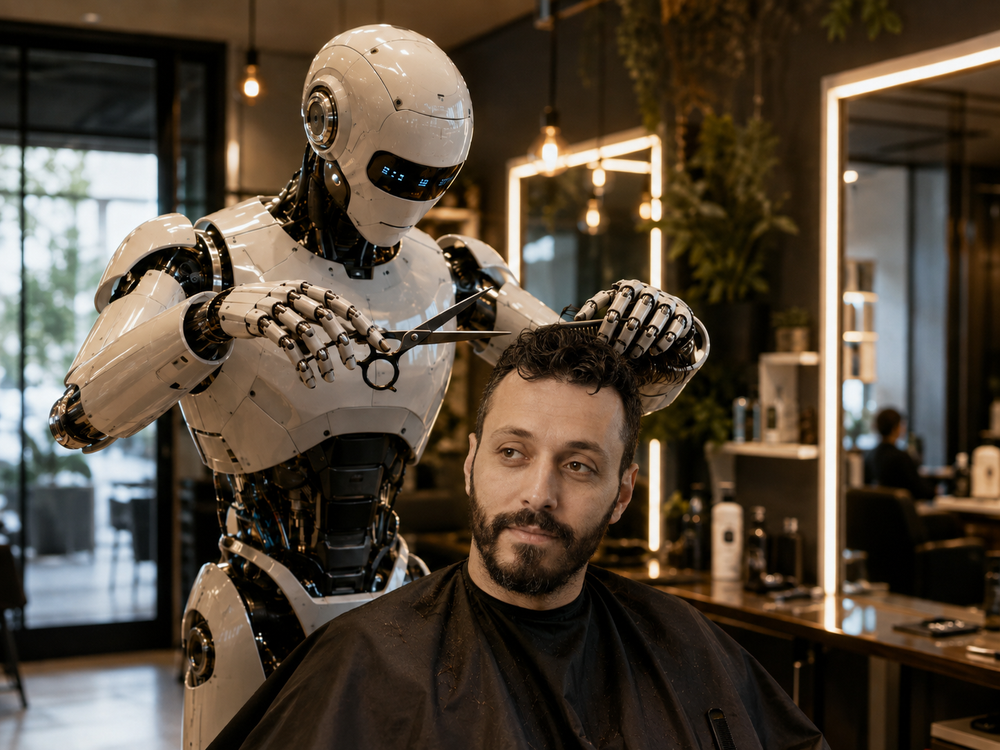
AI and Beauty – Can the Two Co-Exist?
Can technology in general, and AI in particular, coexist with service businesses like a hair salon? Can they actually support each other?
Will a robot ever replace your talented haircutter? Or apply flawless makeup for you? I want to say no, but who knows what the future will bring. Even if it does happen one day, I don’t think it will be anytime soon.
And even if it could, would you even want it?
Isn’t part of coming to a salon the personal touch? The human creative mind? The conversations? The friendship?
At Valery Joseph, I have already established that we are a community. We don’t just provide services at the highest level possible. We connect with people. Our lives intertwine with theirs and vice versa.
So where does technology, and now AI, come into the salon?
For me, AI is not really the story.
The story is constantly asking whether there is a smarter way to do something without losing what makes the business human.
Up until about three years ago, I was using a system so ancient it was probably invented when I was still in the army back in 2005.
Many of our procedures were manual. They were time-consuming, inefficient and left too much room for errors. My receptionists were exhausted from long booking processes, high call volume and the constant influx of clients wanting to book their next appointment. I was exhausted for them!
We knew we needed a new system.
I personally looked at and did demos with so many different platforms. Many of them were good, but they were not what I was looking for. They just didn’t feel right for our type of high-end clientele.
Then one evening, the 16-year-old son of a dear friend, who is honestly brighter than most people I know, did a quick online search and found exactly what I had been looking for: Mangomint.
I remember telling Valery that night, “We are switching systems.” I signed up that night and started setting it up the next morning. Within a relatively short time, we made the official switch.
I had two realizations.
First, I wasn’t nearly as up-to-date with technology as I thought I was if a 16-year-old could solve in minutes what I had been trying to solve for weeks.
Second, technology moves extremely fast, and if we want to remain relevant and continue building the business, we have to keep up with it.
From that point on, I became much more committed to looking for technology that could make the business run better and make life easier for the client.
That became my test.
Does this actually make anyone’s life easier?
With the new booking system, all of our salon databases are connected into one. I can easily move between locations, review schedules and access client history across the business.
The booking process is easier and faster. Confirmation texts and emails clearly show appointment details, which helps reduce misunderstandings.
We also have two-way texting, which makes the salon much more accessible. A client can literally be sitting on a plane and text us about an appointment instead of having to call.
And of course, there is online booking, allowing clients to book from anywhere, at any time.
None of this sounds revolutionary, but that is exactly the point.
Technology doesn’t always need to be revolutionary. Sometimes it just needs to remove friction.
During COVID, that became even clearer.
When everything was closed, we needed a way to keep our relationship with clients alive. We created an automatic form, back then using Google Forms, that allowed clients to request personalized color kits.
We prepared the kits, created tutorial videos and sent instructions so clients could maintain their color at home.
It wasn’t AI.
It was simply using the technology available to solve a problem and stay connected with our clients.
Then, when salons reopened but everyone wanted as little physical interaction as possible, tipping became another concern.
Cash was being passed from one person to another, and both clients and employees wanted a safer option.
So I redesigned a business card for each employee with their personal Venmo QR code. Clients could simply scan it and send their tip directly.
That solution was created during COVID, but we still use it today.
Again, simple.
But very useful.
Now we have AI, and with it so many new platforms and possibilities.
If you know how to use it correctly, it can be an incredible tool.
For example, I converted all of my training manuals into interactive programs that new trainees can access directly from their phones. They can easily be translated into their native language, which makes the learning process quicker and more efficient.
It also becomes a kind of pocket handbook they can go back to whenever they need to review something.
We also use AI in marketing and advertising, business analysis, scheduling, improving workflows and evaluating policies.
And one of the ways I personally find it most useful is to challenge the way I think.
I don’t only use it to agree with me. I can use it to question an idea, argue the other side of a policy or show me something I may not have considered.
It doesn’t have to make the decision for me.
Sometimes it simply helps me make a better one.
Just today, I had a conversation with a client who asked me whether I would eventually reduce the number of front-desk employees once AI can do more.
My answer was very simple.
No.
I don’t believe you can replace human interaction with a machine.
And more importantly, neither Valery nor I want to. Valery is one of the most loyal people I know. He deeply cares about the people who work with him, and I know he would never look at technology simply as a way to take work away from them.
For me, the purpose of technology and AI is not to save money by removing people from their jobs.
It is to remove unnecessary work and give people more time to do what they do best: create, connect and build relationships.
If the front desk spends less time dealing with repetitive administrative work, they have more time for the client.
Less stress.
Less manual work.
More time to greet someone properly, have a conversation, solve a problem and give personal attention.
That is where technology becomes valuable.
Just because something can be automated doesn’t mean it should be.
And that is especially true in a service business.
The client should benefit from the technology without feeling replaced by it.
Booking should be easier. Communication should be faster. Their history should follow them between locations so they don’t have to explain everything from the beginning.
Ideally, the client shouldn’t even have to think about the technology.
They should simply feel that the experience is easier.
There is, however, one place where I draw a very clear line.
I don’t believe AI should replace the artistry itself.
Can it help with inspiration, education or research? Of course.
But I am not interested in a machine replacing the judgment of a hairdresser, colorist or makeup artist.
Each artist brings their own knowledge, experience, instinct and point of view to their work.
That is part of the art.
And it is part of what the client is coming for.
AI can support the artist.
It should never become the artist.
I’m always looking for the next thing that can make us better. Some ideas are already in the works, others may come later.
But with every new system, platform or technology, I come back to the same question:
Does this make the business better and the client experience better?
If the answer is yes, I’m interested.
If the technology simply removes a human interaction that actually has value, then I’m not.
Technology will continue to change, and AI will continue to become more capable.
But I never want efficiency to come at the expense of hospitality.
For me, that is the balance.
Use technology to remove the friction.
And give people more time to be people.
How are you using technology to improve your business without losing the human touch?
Get new posts by email
New notes on running a luxury salon, sent straight to your inbox. No spam, just what I'd tell you if you were standing on the floor with me.
Subscribe
Discussion